Building a Circular Economy Starts with Local Manufacturing
For many years, Australia was known for making things. From packaging and manufactured goods to agricultural products and industrial supplies, a significant proportion of the products Australians used every day were produced locally.
Today, the story is very different.
As manufacturing has moved offshore, Australia has become increasingly dependent on imported goods. At the same time, creating a truly effective circular economy has become more difficult because the products we consume are often manufactured thousands of kilometres away from where they are used, collected and recycled.
At Plastics 2000, we believe local manufacturing plays a critical role in creating a more sustainable future and a stronger circular economy for Australia.
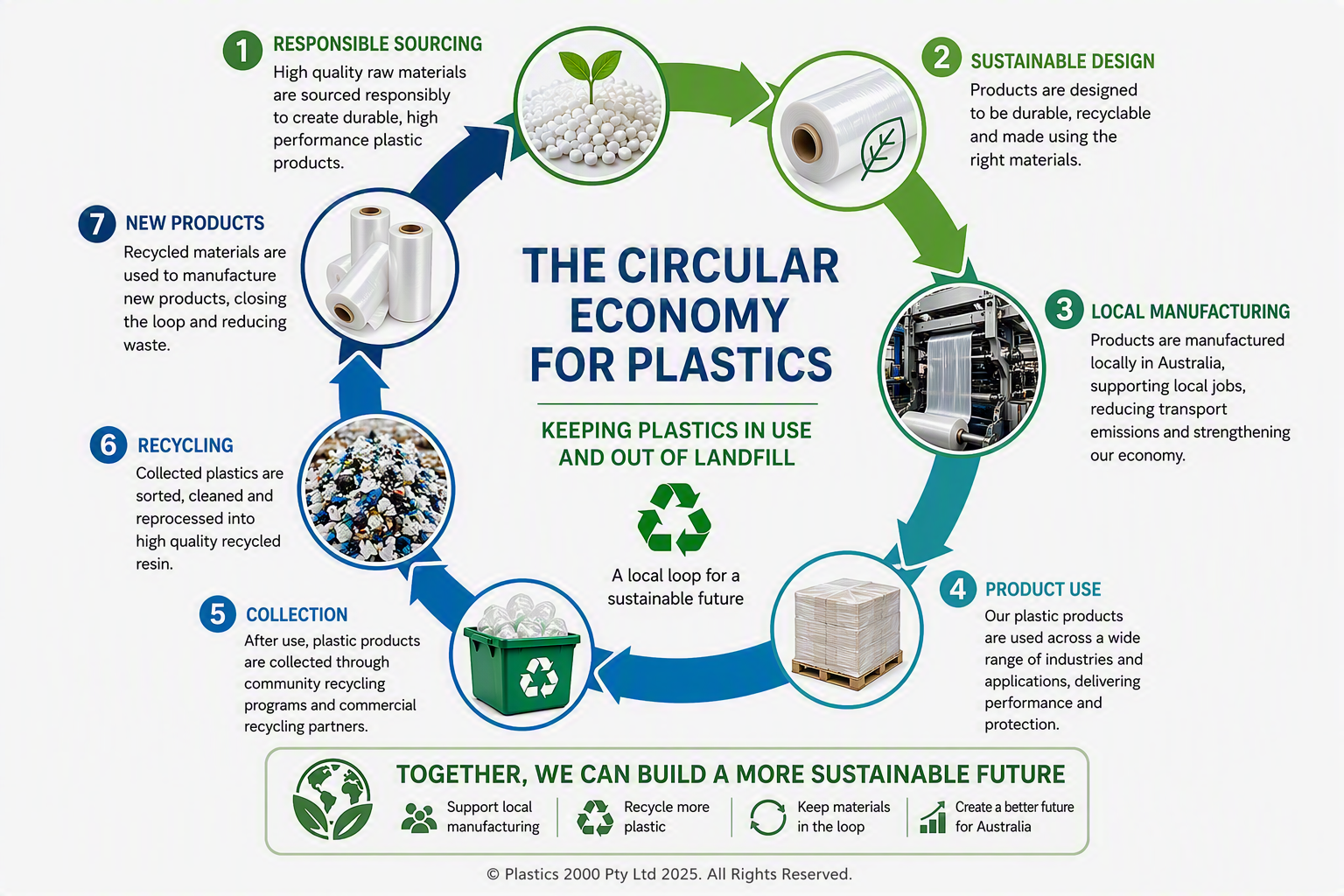
What is a Circular Economy?
A circular economy aims to keep materials in use for as long as possible through reuse, recycling and remanufacturing.
In a traditional “take, make, dispose” economy, valuable materials are discarded after use.
In a circular economy:
- Products are designed to be recycled.
- Materials are recovered locally.
- Recycled materials are processed and reused.
- New products are manufactured from those recovered resources.
The closer these activities occur to one another, the more efficient and sustainable the system becomes.
Australia’s Manufacturing Challenge
Over the past few decades, Australia’s manufacturing sector has steadily declined as a share of the national economy.
In 1990, manufacturing contributed almost 14% of Australia’s GDP. Today, manufacturing contributes around 5% of GDP, highlighting the long-term shift towards imported goods and offshore production. [theglobaleconomy.com], [data.worldbank.org]
While global supply chains have delivered lower-cost products, they have also created challenges for local industry, supply chain resilience and recycling outcomes.
When products are manufactured overseas, Australia often loses the opportunity to turn locally recovered materials back into locally made products.
Why Local Manufacturing Supports Recycling
One of the greatest strengths of local manufacturing is its ability to create demand for recycled materials.
When products are made in Australia:
- Materials are collected locally.
- Materials are reprocessed locally.
- Manufacturers purchase recycled material.
- New products are manufactured and sold locally.
This creates a genuine circular economy.
Without local manufacturers, many recyclable materials have fewer end markets and less opportunity to be converted into new products.
Supporting Australian manufacturing helps create demand for Australian recycled materials and encourages further investment in collection, processing and recycling infrastructure.
The Plastics Industry’s Opportunity
Australia consumed approximately 4 million tonnes of plastic products and packaging in 2023-24, while only around 14% of end-of-life plastics were recovered through recycling or energy recovery. [dcceew.gov.au]
At the same time, plastic consumption continues to grow, creating both a challenge and an opportunity for industry. [wp.csiro.au], [dcceew.gov.au]
Research into Australia’s plastics flows shows that only around 38% of plastic products consumed in Australia are manufactured locally, with approximately 62% arriving as imported finished or semi-finished goods. [wp.csiro.au]
This means much of the value creation associated with those materials occurs overseas rather than supporting Australian jobs, investment and recycling markets.
Why Buying Australian Matters
Choosing Australian-made products delivers benefits beyond supporting local jobs.
It helps:
- Strengthen domestic supply chains
- Encourage investment in recycling infrastructure
- Reduce transport distances
- Improve supply chain security
- Create demand for recycled materials
- Support Australian manufacturing jobs and skills
Every locally manufactured product helps keep more economic activity and material value within Australia.
The Plastics 2000 Commitment
At Plastics 2000, we believe that manufacturing and sustainability go hand in hand.
By producing polyethylene film products in Australia, we help maintain local manufacturing capability while supporting the long-term development of a more circular economy.
When plastic products can be collected, recycled, reprocessed and remanufactured within Australia, the environmental and economic benefits remain within our communities.
Supporting local manufacturing is not simply about buying Australian. It is about creating the conditions needed for materials to be recovered, reused and turned into new products again and again.
That is what a true circular economy looks like, and it starts with manufacturing close to home.